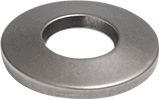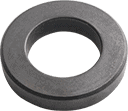
Washer Geometry
The physical dimensions of a Belleville washer directly impact its performance. Key geometric factors include:
- Thickness
- Outer and inner diameter
- Cone height (free height)
A thicker washer, for instance, increases load capacity but reduces deflection. On the other hand, a taller cone height allows for greater deflection at lower loads. Because of these relationships, even small dimensional changes can significantly alter the load deflection curve.
Stacking Configuration
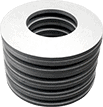
Stacking is one of the most effective ways to modify a Belleville washer’s behavior. By arranging washers in different configurations, engineers can tailor the load deflection curve to meet specific requirements.
- Parallel stacking increases load capacity while keeping deflection constant.
- Series stacking increases deflection while maintaining the same load.
- Combined stacks adjust both load and deflection simultaneously.
Therefore, a properly designed stack can dramatically change system performance without altering individual washer dimensions.
Friction and Surface Conditions
Friction between stacked washers or contact surfaces also affects the load deflection curve. When friction increases, energy loss occurs within the system. As a result, the actual performance may differ from theoretical calculations.
Surface finishes, lubrication, and coatings all influence friction levels. For this reason, engineers must account for real-world conditions when designing assemblies.
Temperature and Operating Environment
Temperature has a direct impact on material properties and, consequently, the load deflection curve. As temperatures rise, materials may lose stiffness, which can reduce load capacity and alter deflection behavior.
In applications with frequent thermal cycling, such as power generation or exhaust systems, this effect becomes even more significant. Therefore, selecting the right material and design ensures consistent performance across varying conditions.
Manufacturing Precision
Consistent manufacturing processes are essential for predictable results. Variations in thickness, heat treatment, or forming can lead to inconsistencies in the load deflection curve.
At American Belleville, precision manufacturing ensures that each washer performs as expected. This consistency is critical for applications where reliability and repeatability are non-negotiable.
Optimizing Performance with the Right Design
Designing around the load deflection curve allows engineers to fine-tune performance for specific applications. By carefully selecting materials, adjusting geometry, and choosing the correct stacking method, it is possible to achieve precise load and deflection characteristics.
This level of control improves joint reliability, reduces maintenance, and enhances overall system efficiency.
American Belleville: Engineered for Precision and Performance
At American Belleville, we manufacture high-quality disc springs designed to meet exact performance requirements. With approximately 90% of our products made in the USA, we deliver consistent quality and dependable supply for critical applications.
Whether you need a custom stack configuration or assistance interpreting a load deflection curve, our engineering team is ready to help.
Contact American Belleville today to discuss your application and find the right solution for your design.