Washer Geometry
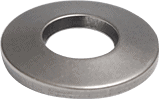
Small shifts in dimensions cause major changes in performance. Three key measurements shape the curve:
- Thickness: Increasing thickness boosts load capacity but restricts deflection.
- Cone Height: A taller cone allows greater deflection under lower initial loads.
- Diameter Ratio: Adjusts overall spring rate and stiffness.
A thicker washer, for instance, increases load capacity but reduces deflection. On the other hand, a taller cone height allows for greater deflection at lower loads. Because of these relationships, even small dimensional changes can significantly alter the load deflection curve.
Stacking Configuration
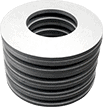
Stacking washers lets you customize the load deflection curve without changing individual component sizes:
- Parallel Stacking (Nested): Multiplies load capacity while keeping deflection the same.
- Series Stacking (Opposed): Multiplies overall deflection while keeping load capacity constant.
- Combination Stacking: Adjusts both load and deflection simultaneously for custom performance profiles.
Friction and Surface Conditions
Friction between stacked washers or contact surfaces alters real-world behavior compared to theoretical calculations:
- Higher friction absorbs energy, creating hysteresis between compression and release.
- Surface finishes, platings, and lubricants directly influence friction levels.
- Factoring in friction ensures your assembly performs reliably outside the lab.
Temperature and Operating Environment
Extreme temperatures alter metal stiffness and shift the curve:
- Heat: Reduces material stiffness, lowering load capacity and increasing deflection.
- Thermal Cycling: Repeated heating and cooling causes expansion and contraction, risking preload loss in systems like turbines or exhaust manifolds.
Manufacturing Precision
Unintended variations in material thickness, heat treatment, or forming lead to unpredictable spring curves. Precision manufacturing guarantees that every washer meets strict tolerances for repeatable, reliable performance.
Optimizing Performance with the Right Design
Designing around the load deflection curve allows engineers to fine-tune performance for specific applications. By carefully selecting materials, adjusting geometry, and choosing the correct stacking method, it is possible to achieve precise load and deflection characteristics.
This level of control improves joint reliability, reduces maintenance, and enhances overall system efficiency.
American Belleville: Engineered for Precision and Performance
Controlling the load deflection curve gives you precise power over your bolted joints. By specifying the right material, dimensions, and stack method, you improve joint integrity, reduce maintenance, and prevent costly downtime.
At American Belleville, we manufacture precision disc springs engineered for demanding environments. Nearly all of our products are made in the USA, our components deliver the exact load and deflection performance your critical applications require.
Need help interpreting a load deflection curve or sizing a custom stack? Contact our engineering team today to build a reliable solution for your application.